
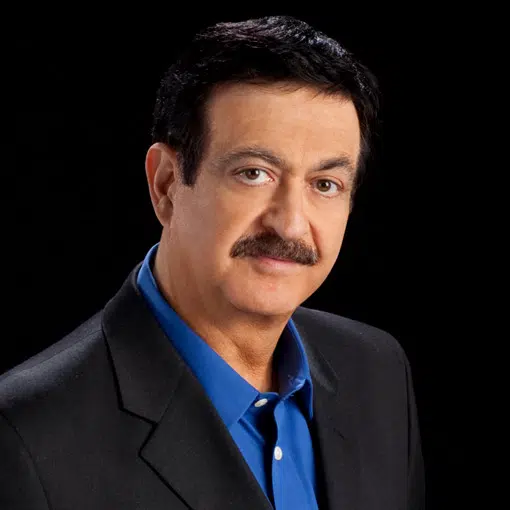
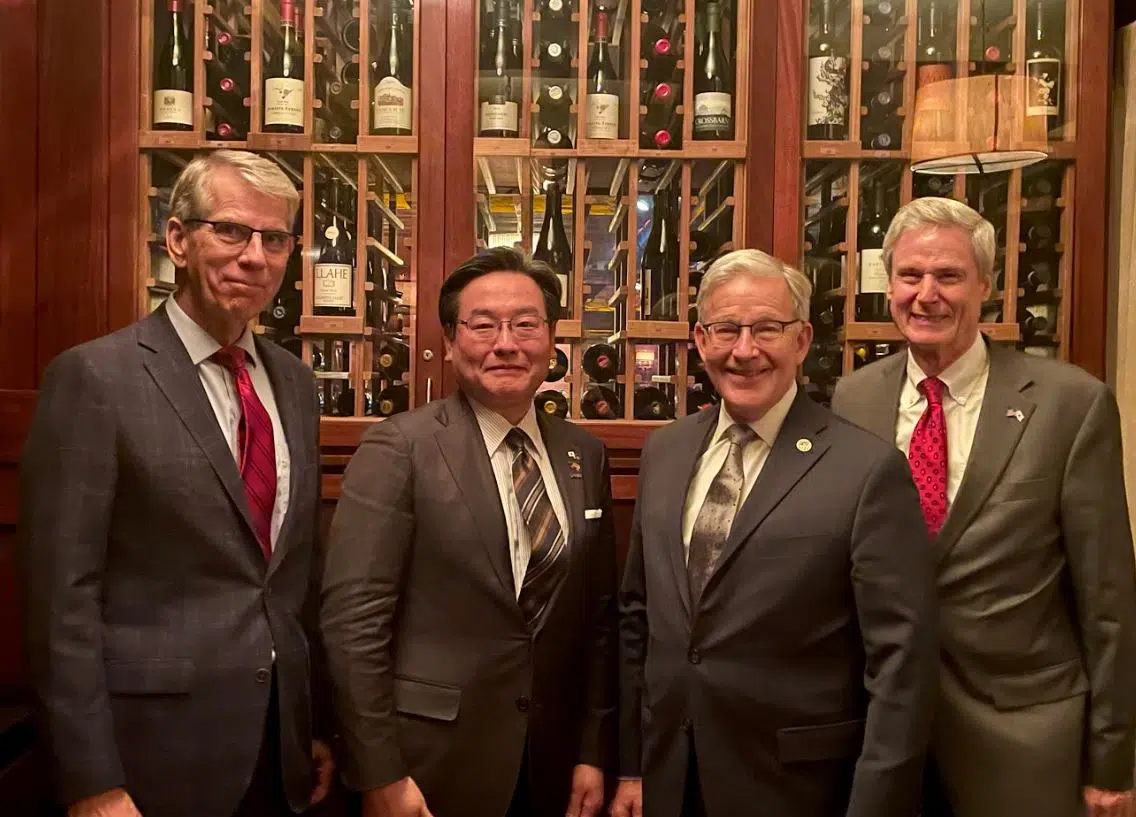
OMAHA – Secretary of State Bob Evnen joined Lieutenant Governor Joe Kelly Friday in welcoming Mr. TAJIMA Hiroshi, the Consul-General of Japan in Chicago, to Nebraska. Mr. TAJIMA is visiting Nebraska to meet with several elected officials to discuss economic collaboration between the U.S., Japan and Indo-Pacific countries. “It was an honor to join Lieutenant Governor Joe Kelly in welcoming Mr. TAJIMA to our state,” Secretary Evnen said. “Nebraska has a strong business partnership with Japan. This visit was a great opportunity to discuss our economic goals with Japan and Indo-Pacific nations.” Secretary Evnen and Deputy Secretary of State Cindi Allen attended a dinner Thursday ahead of a seminar hosted Friday by the Midwest International Trade Association (MITA) and the National Association of Japan-America Societies (NAJAS). The organizations held the seminar at Creighton University’s Harper Center. Consul-General TAJIMA Hiroshi presented an overview of Japan’s economic, trade and security policy as it relates to the U.S. and the Indo-Pacific countries. Also at the seminar, Mr. NISHIZAWA Tomofumi, Executive Director of the Japan External Trade Office in Chicago, spoke on trade, investment and economic trends between Japan and Nebraska. Dr. Ellen L. Frost, Senior Advisor and Fellow to the Washington Office of the East-West Center, highlighted Japan’s emerging role as a regional leader while remaining a key U.S. partner in trade and security. “Japan continues to be a strong economic partner to Nebraska,” Evnen said. “We look forward to more opportunities that will continue to build partnerships between our countries.”According to the Nebraska Department of Agriculture, Japan is Nebraska’s top market for beef and pork. Japan accounts for 25.2% of Nebraska’s beef exports and 56% of Nebraska’s pork exports. Japan is also Nebraska’s largest export market for pork and eggs. Japan is Nebraska’s second-largest export market for beef and all ag exports.
Note: Japanese names are typically listed with the family name first, followed by their given names. In addition, Japanese family names are commonly capitalized to distinguish the family name.