
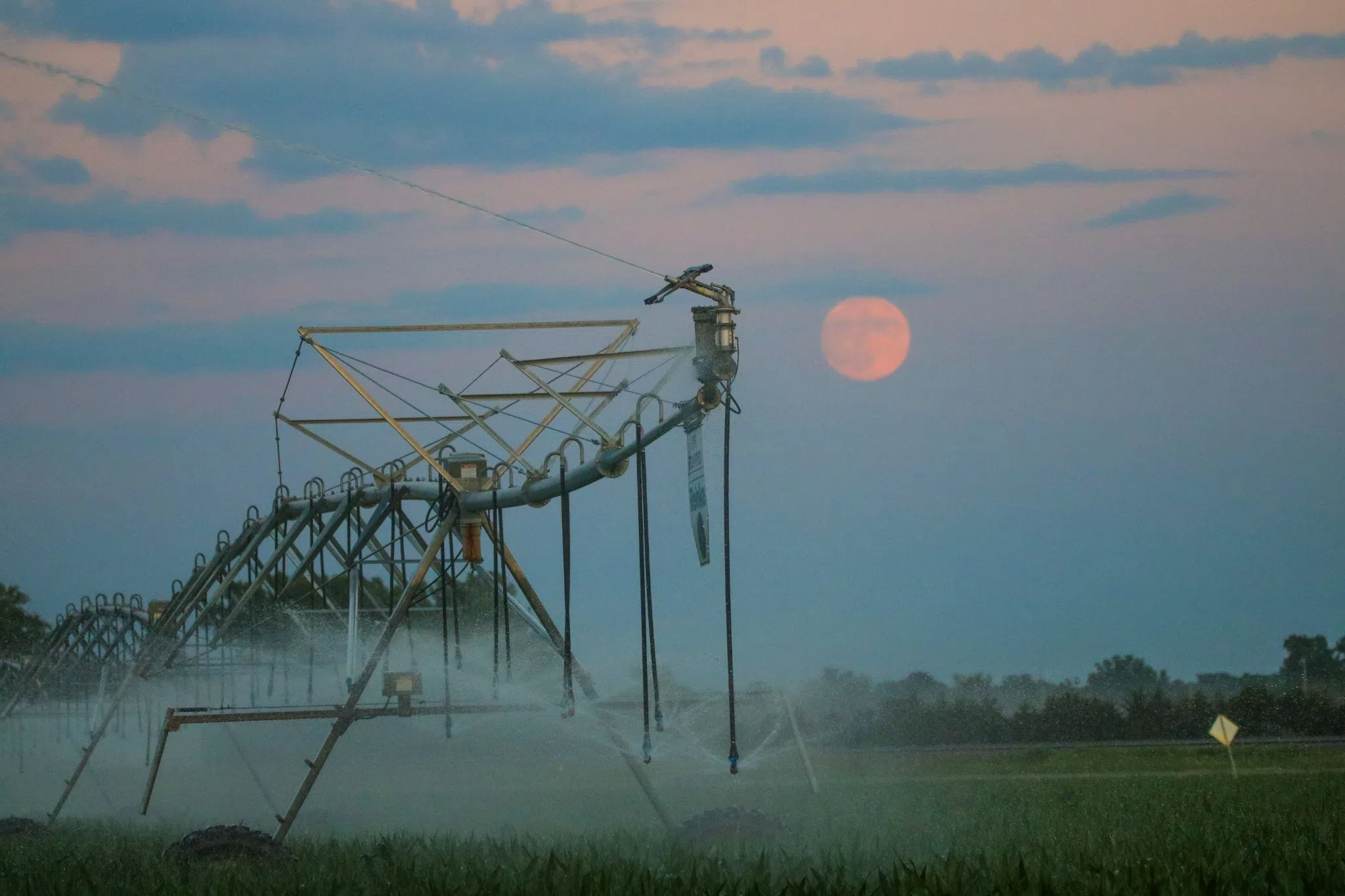
Pivot with the full moon in the background, (Brian Neben, Courtesy)
HOLDREGE — Early this February, The Central Nebraska Public Power and Irrigation District (Central) diverted over 3,000 acre-feet of additional water for intentional recharge.
This follows immediately on the heels of 2023 deliveries which eclipsed 17,000 acre-feet. Intentional recharge is made possible through Central Water Service Agreements with the Nebraska Department of Natural Resources (NeDNR) and the Platte River Recovery
Implementation Program (PRRIP).
These commitments from PRRIP and NeDNR recognize the value and important benefits of recharge. Combined, the agreements commit nearly $30 million for recharge deliveries to sustain the benefits they are realizing. The long-term recharge agreement contracts provide revenue to Central, which helps offset operation, maintenance and delivery costs to the District.
The PRRIP agreement provided $9.15 million for groundwater aquifer recharge services associated with the Phelps Canal and Elwood Reservoir with a term extending out for at least 20 years. PRRIP also provided Central $2 million to assist with the Elwood Dam Seepage Mitigation project to help support the infrastructure that is important to the recharge activities.
In addition, NeDNR provided $19.1 million for excess flow diversions into the E65 Canal, Phelps Canal, Elwood Reservoir and several Waterfowl Production Areas over the next 15 years. In partnership with the Tri-Basin and Central Platte Natural Resource Districts, out of the $19.1 million, Tri-Basin contributed $1.19 million while the Central Platte NRD contributed $1.2 million. In return, both Tri-Basin and Central Platte receive an annual benefit percentage based on their financial contribution when excess flows are delivered to the Tri-County irrigated area.
There are two separate and very distinct types of recharge, one is known as intentional and the other is known as incidental. The long-term agreements between Central, PRRIP and NeDNR are part of intentional recharge efforts.
Recharge that occurs from diverting water into Central’s canal system for irrigation deliveries is referred to, and should be called, incidental recharge. Over the last 80 years incidental recharge has resulted in an artificially high water table known as “The Mound.”
Not to be confused with groundwater, the mound is technically surface water stored underground with permit authorization as Central’s approved “U-2 appropriation for Incidental Underground Water Storage rights.” The mound’s creation was funded through revenue generated by Central’s operations over the past 80 years. Those revenue sources are largely provided by energy sales and water service deliveries, with energy sales accounting for nearly 70% of gross revenue from 2011 to 2021. More recently, support from residential leases around area lakes and these recharge agreements have also helped contribute to operations and maintenance of the District’s aging
infrastructure and helped keep costs for all customers as low as possible. The artificially high-water table created by Central’s mound also supports the Imported Water Supply Credit to the Republican Basin while providing a positive financial benefit to groundwater pumpers in the Tri-County irrigated area.
To better understand the volume of recharge delivered to the Tri-County irrigated area, in 2023 intentional recharge yielded approximately 17,000 acre-feet of water and was paid by NeNDR and PRRIP through the long-term recharge agreements providing approximately $700,000 in revenue. The incidental recharge in 2023, created from surface water irrigation use, provided over 100,000 acre-feet and was paid for by Central’s customers. Since beginning operation in 1942, it is estimated Central’s project has already contributed approximately 10.5 million acre-feet to create the mound. In order to contrast this volume of water, the Great Salt Lake holds around 15 million acre-feet. Lake McConaughy holds 1.7 million acre-feet at full pool while Harlan County Reservoir holds 315k acre-feet at full pool.
Central has been supporting groundwater management by diverting excess flows for intentional recharge through contracts starting nearly 15 years ago. This support stabilizes the artificially high-water table (created from the incidental recharge) while supporting stream flows in the Platte and Republican watersheds. This recharge activity is a very valuable opportunity for all our NRD partners in minimizing the impact of regulatory requirements on groundwater pumpers. This impact ranges across the entire region from McConaughy to Marquette and Oconto to Orleans.
Approximately 500,000 irrigated acres lie within Kearney, Phelps and Gosper counties with approximately 100,000 acres being supported by surface water from Central. Many surface water customers also have the capability to irrigate by pumping water from their well. The reduced pumping cost on comingled acres is a benefit that Central customers have been paying to receive since their grandparents started taking District water.
Central recognizes the importance of recharge to our customers, along with others that receive the benefits created by our surface water irrigated infrastructure and long-standing customers. Central’s investment and customer commitment is ongoing with construction efforts that secure the surface water irrigated infrastructure. These investments make it possible to sustain the benefits and the heritage of surface water deliveries that helped create prosperity in agriculture across the Tri-County area along with a large part of Central and South Central Nebraska.
Central’s ongoing projects include:
- Elwood Dam Seepage Mitigation Project that is scheduled to be completed in summer of 2024 with $6 million secured (CNPPID, PRRIP, NeDNR). This project allows for the continued use of the facility.
- The E65 New Siphon is a $23 million project scheduled for operation in 2026 with $9 million of the funding coming from the Nebraska Water Sustainability Fund. This addresses aging infrastructure critical for all E65 canal deliveries, including water for Elwood Reservoir.
- Kingsley Dam Refacing is still being evaluated to determine the best alternative. Early projections indicate project costs ranging from $80 – $200 million.
The foresight of Central Directors to reserve funds over the past ten years provides Central the ability to finance these important projects through the use of revenue bonding if necessary, while maintaining local control in the region.
Because Central is not a taxing authority, the District must continually evaluate ways to enhance or create new revenue opportunities that can help to offset customer fees that will be required for these projects as well as ongoing operations. Ownership of facilities like Kingsley Dam is an honor that comes with responsibility and a long-term commitment to sustain the realized benefits provided by these structures for the regional agricultural producers here in Nebraska.
Today, Central is investigating a new $13 million investment for surface water customers that will improve deliveries, support customer retention, and maintain the heritage and tremendous recharge advantage of surface water use for crop production in the District’s irrigated area.
The commitment of Central irrigators over the last 80 years is the reason why limited regulatory requirements exist for regional groundwater pumpers and why the Tri-County irrigated area is one of the most prosperous agricultural regions in the world. Central appreciates support as we constantly evaluate the best opportunities to increase and maintain our long-term revenue streams that will offset the cost to Central irrigators while sustaining water supplies.