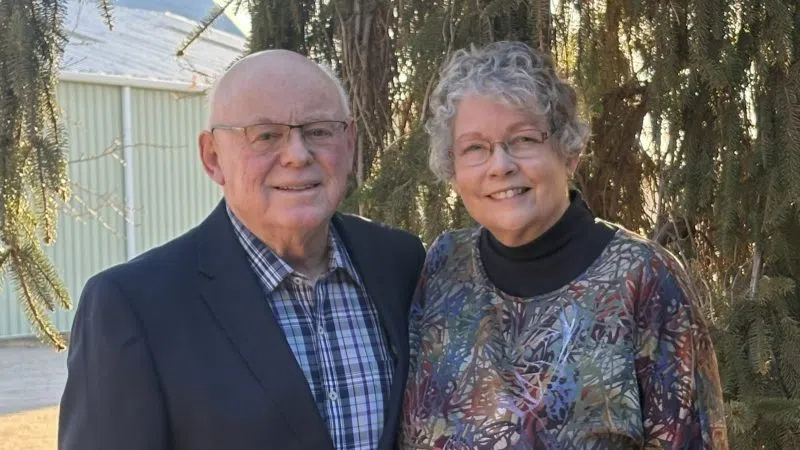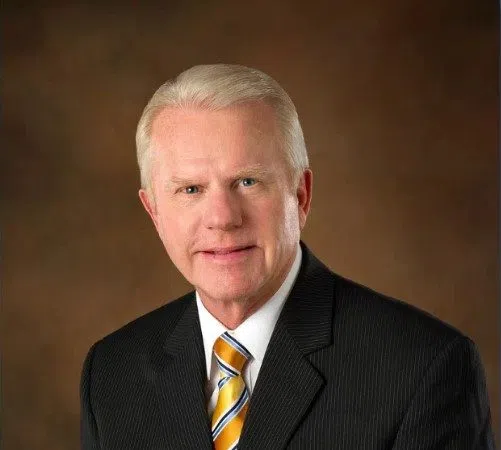
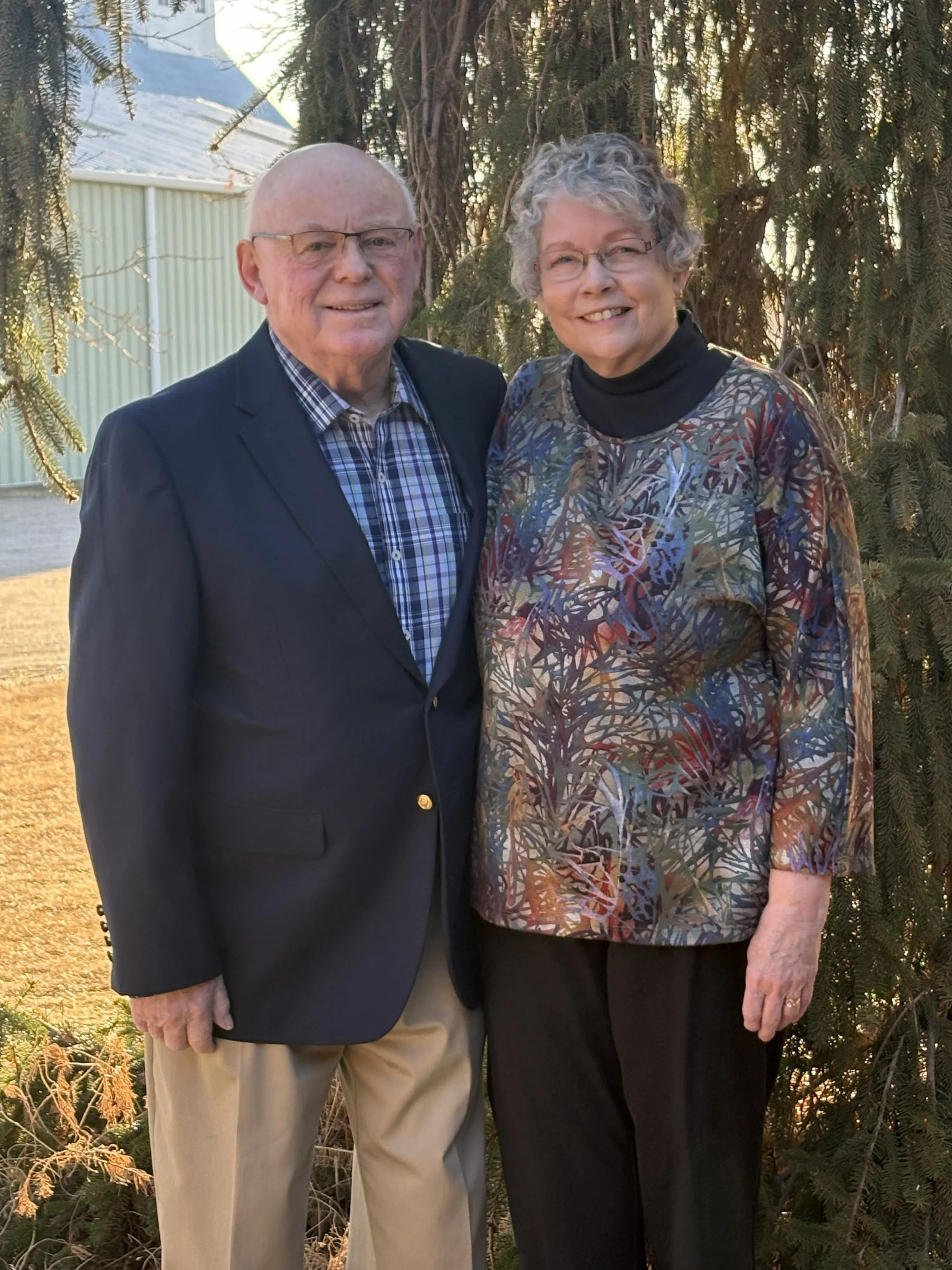
Gary White and Mary White, (White Family, Courtesy)
LEXINGTON — For over 40 years, Gary and Mary White have been part of the fabric of the Dawson County livestock industry with White Land and Cattle Company northeast of Lexington. What started as a small operation grew to 2,500 head capacity.
The history of the White family in Dawson County has deep roots and can be traced back to the 1880s.
Gary’s great-great grandfather Thomas White was born in England in 1830. After marrying Mary Frost in 1855, the couple made the decision to come to America with their two children in 1859.
The family first came to Iroquois County in Illinois where Thomas took to farming and raising livestock on the side, finding success in both.
In 1880, the couple made a trip out west to Dawson County where Thomas purchased land in Section 15 from the Union Pacific Railroad and entered a homestead in Section 22.
The next spring, after purchasing the property in Nebraska, Thomas and his son Charles came back to Dawson County where they remained for a year establishing a farm and preparing for the entire family to move, which they did in the spring of 1882.
The family transported all they owned, including five carloads of horses and cattle, which would prove to be the nucleus of the herds the family would later maintain.
As a history of the White’s states, “It was still early enough in the settlement of the region for them to meet with some hardships incident to the life of the pioneer but as time went on, one improvement after another was made on the farm and more land was purchased as needed until the estate was known as one of the largest and best in the county.”
The White family has a long history of involvement in agriculture programs, including 4-H.
Gary’s great grandfather, Clifford White, was the first 4-H leader in the county. Gary’s grandfather Harold White was among eight members who were members of the first Dawson County 4-H club that was established in 1920.
The club meetings were first held at the White farm north of Lexington.
Gary White was born on May 9, 1947, the first of three children born to the union of Pauline Louise White and H. Keith White in Lexington. His two siblings were Larry and Debra.
Keith had taken up the family trade and farmed and fed cattle all his life and was a fat cattle buyer for 15 years.
Pauline was a dedicated homemaker, and along with Keith, were lifelong members of the First United Methodist Church in Lexington. Pauline taught Sunday School for many years.
Gary grew up on the family farm and was actively involved in 4-H showing cattle and sheep. His father Keith, along with Chris Rickertsen, served as the leader of Horseshoe Bend 4-H Club for 20 years.
Work on the farm wasn’t always glamorous, and Gary remembers being sent by his father to cut grass and weeds, with Keith often saying, “You never know when the President will come to the yard.”
Gary noted that President Eisenhower failed to ever make an appearance.
Elementary education for Gary took place at District 25, known as the Horseshoe Bend School, located five miles northeast of Lexington. It was noted that members of the White family had been attending the school since 1909.
Gary later attended Lexington High School and graduated with the class of 1965.
At this time, Gary noted that he wasn’t sure what he would do as a career. He had thought in high school that he might go into coaching and teaching. He noted he had not planned on returning to the Lexington area.
The other half of the White team, Mary Rhone was born on Dec. 23, 1952, to Marjorie and Dahlas Rhone of Cozad. Marjorie and Dahlas had married on June 25, 1950.
The couple made their home on the Rhone family farm south of Cozad, started by Dahlas’ grandfather, JT Rhone, where they raised their two daughters, Mary and Lynn.
Marjorie was a lifetime member of the First United Methodist Church in Cozad and she was a member of the Cozad China Painter’s Club.
Dahlas worked on the family farm all of his life and had great love for the land, animals of all kinds and took great pride in his Angus cow herd.
In addition, Dahlas’ collection of exotic animals, ranging from deer and llamas to bison and even camels and zebras, was well known throughout the area. He always enjoyed showing off the animals to the many busloads of schoolchildren who came to tour the farm.
Mary grew up with the exotic animals on the farm, and recalled how many cars, especially on Sundays, would pull over to the side of the road, with people getting out to get a better look
She said she never knew what was going to be in the back of the trailer of some animal dealer that came out to the farm. The dealers themselves were characters in their own right.
Mary recalled one time a truck stopped with caged lions that had been used in a Disney production and the horses in the nearby pen went berserk.
Mary also recalled the day all of the bison were rounded up, which was quite the afternoon given how hard they were to control.
Continuing his education, Gary attended the University of Nebraska – Lincoln where he majored in animal science and graduated with his bachelor’s degree in 1969.
During his senior year in college, Gary was encouraged by his peers to take a class on International Food Problems. As it turned out, the Peace Corp was recruiting seniors with farm backgrounds to go to Colombia as volunteers.
Gary was among nine Nebraska students and several from Cornell University who made the trip down to the South American country where he was assigned to work with the National Federation of Coffee Growers of Colombia to do livestock extension work.
It was during a day in Colombia, when Gary was climbing a mountain trail and sat down on a tree stump and admired the beauty of the view that he thought back to his Nebraska roots and thought, “You know, Dawson County is a pretty good place to live.”
That was a seed of a thought that would bring him back to work with the family cattle business.
In a story worth a feature of its own, Gary and his friend Dick Lloyd flew to Panama City from Bogota Colombia, cashed in their plane tickets home to buy Honda motorcycles and made the 3,000-mile drive back to Nebraska, with Lloyd continuing on to New York.
Gary remarked that he would not make that same type of trip today.
Gary would return to the University of Nebraska – Lincoln to receive his master’s degree in beef production. During this time, he helped to teach the subject to Japanese students who were part of a training program through the university.
While he never would have envisioned it, Gary would make his return to Nebraska to work with his parents as a part of the family cattle operation.
It was after his return to Dawson County that Gary met Mary Rhone, a Nebraska Wesleyan graduate, on a blind date while she was working as a legal secretary for Armbruster Nelson and Hart in Cozad.
Gary noted Mary’s down-to-earth mindset stood out to him and that she was from a farm background, the same as him. Mary said that she had known of Gary before she formally met him, having seen his picture in the paper, usually involving him showing animals through 4-H.
The couple dated around a year before they were married in June 1984.
The couple had two daughters; Sarah was born in 1989 and Kristin in 1990.
Both girls also attended District 25 in their early years, just as prior generations of the White family had.
“We can all get together and compare notes on how much it has changed since my great-grandpa started school there in 1909,” Sarah was quoted as saying by the Tri-City Tribune when she was 10 years old.
Sarah also said of her family, “We were all raised on the same farm right here in Lexington. It’s fun to think we may have all climbed the same trees and walked the same trails.”
She learned that her favorite spot on the creek to go sledding was the same place where her great-grandfather and his family used to hold the neighborhood Fourth of July picnics and play baseball.
Sarah also spoke of a unique tradition in the White family.
“Imagine this: You wake up one morning and remember it’s your birthday. All of those nice thoughts of presents, cake and ice cream are going through your head, then your little sister comes quietly into your room and smack! Suddenly you have a teaspoon of butter on the end of your nose…Having your nose buttered on your birthday has been a White family tradition for as long as anyone can remember.”
White Land and Cattle Company had started small with 300 to 400 head of cattle, but more pens would be added over the years which grew into an operation that could manage 2,500 head.
In addition to their operation, Gary said they helped to feed cattle of other producers in Dawson County, Custer County, Lincoln County and Cherry County. He noted that he enjoyed collaborating with ranchers and helping nurture their premium cattle.
Gary more closely described the daily operation in an interview Certified Angus Beef did on White Land and Cattle Company.
“The family works with a nutritionist and uses ultrasound technology to help all cattle reach an ideal finished end point. Around 80 to 90 days pre-harvest, they are routinely divided into two to three marketing groups.”
“Sorting cattle allows us to reach optimum feed efficiency and cost of gain,” White said.
“The feeding program includes a ration of wet and dry-rolled corn, silage, hay and wet distillers grains. South-central Nebraska is a great location for supplying those feedstuffs and fed-cattle markets.”
Cow-calf producers may retain ownership, partner with the feedlot or sell calves outright, but regardless of the arrangement they’ll still get feedlot information back to help perfect their herds.
“I try to be the most efficient I can for the customer,” Gary said. “I work with each one to communicate their individual needs into the feeding experience.”
Gary worked with his father Keith until his death at the age of 89 on Oct. 23, 2011. Gary continued to manage the company in the following years.
Gary said that he always enjoyed working with livestock, but he quipped that he was not the best farmer, he said he just copied what his neighbors did.
Mary said that Gary loved the book work and the organization, he still loves it to this day she added.
Speaking of the livestock work, Gary said that you must enjoy the job, because cattle need care at all hours of the day, no matter the conditions. He also noted while the work could be hard, he enjoyed the people who worked the operation with him, usually one or two employees at a time.
Gary retired from the business in 2018 and now rents the feedlot to Jake Wolfinger with Four Plus Feeders and the farmland is rented to Jaycob O’Hanlon. They also rent their Rhone ground to Corey Bender and Terry Crawford.
When asked if he misses the livestock work, Gary said right after he retired, he did find himself missing it but then smiled and said the longer he is retired, it’s not so hard to miss.
Outside of the feedlot, Gary and Mary have been longtime members of the Frist United Methodist Church, with Gary serving on the several committees including the trustees.
The couple is also members of the Dawson County Farm Bureau and served as leaders for 14 years of the Little Hummers Llama 4-H club.
Gary is a member of the Dawson County Cattlemen and served on the Nebraska Cattleman Foundation board of directors. He also served on the Dawson County Fair Board for 29 years and is a current member of the Central Platte Rangeland Alliance, which conducts prescribed burns to control the “green glacier” of cedar trees in pastures.
Mary has volunteered her time for over a decade at the Dawson County Historical Museum, Gary quipped, “She always liked antiques, I think that is why she married me!”
Today, Sarah, married to Logan Tuttle, teaches writing at Seward Middle School. The couple have two children, Lee who is four and Gemma is two.
Kristin recently moved to Raleigh, North Carolina and works in sales for a merchandising and promotional company.
When asked about what his advice would be for those new to livestock work, Gary said, “You have to enjoy it, love it.” He added that keeping good records is essential, something made easier by modern technology and in order to survive, you have to understand risk management.
Mary said farm and livestock work is hard work seven days a week, but it is a wonderful lifestyle and worth it.
More than anything, Gary said he enjoyed the people he worked with while cattle feeding all of those years. He said the right people can help make the hard work easier.
The White family is grateful for the foresight of their ancestors and feel blessed to have been able to live, work and raise a family in the Lexington area.