
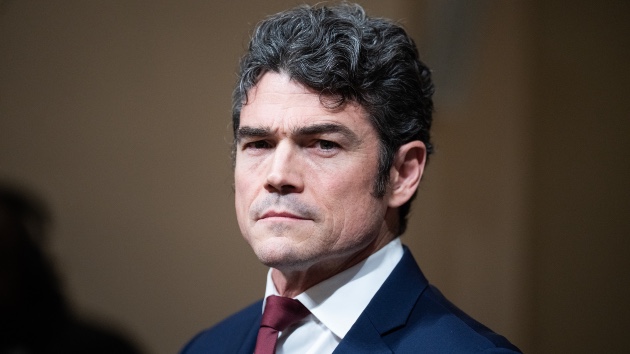
(WASHINGTON) — The Trump administration’s top counterterrorism official, Joe Kent, announced his resignation Tuesday over opposition to the Iran war, becoming the highest-profile administration official to step down publicly over the conflict.
In a resignation letter posted publicly on social media, Kent said he could not “in good conscience” support the war, which is now in its third week.
“Iran posed no imminent threat to our nation, and it is clear that we started this war due to pressure from Israel and its powerful American lobby,” Kent, who served as the director of the National Counterterrorism Center, wrote.
President Donald Trump, in his several justifications for starting the war on Iran, has repeatedly said Tehran posed an “imminent threat” to the U.S. and that the U.S. was “very nearly under threat.”
Early on in the conflict, Secretary of State Marco Rubio said the U.S. strikes were triggered in part because the U.S. knew Israel was going to attack Iran and that Iran would retaliate but that Israel didn’t force Trump’s hand. Trump also denied Israel pulled the U.S. into the war, saying, “If anything, I might have forced Israel’s hand.”
ABC News has reached out to the White House and several Israeli officials for comment.
Trump on Tuesday reacted to Kent’s letter while taking questions at a bilateral meeting with Ireland’s Taoiseach Michael Martin in the Oval Office.
“Well, I read his statement. I always thought he was a nice guy, but I always thought he was weak on security, very weak on security,” Trump said. “I didn’t know him well, but I thought he seemed like a pretty nice guy.”
“But when I read a statement, I realized that it’s a good thing that he’s out,” Trump added. “Because he said that Iran was not a threat. Iran was a threat. Every country realized what a threat Iran was. The question is whether or not they wanted to do something about it. And many people, many of the greatest military scholars, are saying for years that [the] president should have taken out Iran because they wanted a nuclear weapon.”
The National Counterterrorism Center is housed within the Office of the Director of National Intelligence, led by Tulsi Gabbard. ABC News has reached out to ODNI for comment.
ODNI says Kent oversaw the U.S. counterterrorism and counternarcotics enterprise and, according to his biography, he served as the principal counterterrorism adviser to the president.
Kent is a combat veteran who served more than 20 years in the U.S. Army and completed 11 combat deployments in the Middle East. Before joining the Trump administration, he ran two unsuccessful campaigns for Congress.
Kent also invoked a deeply personal loss in explaining his decision to step down: he is a Gold Star husband whose late wife, Navy Senior Chief Petty Officer Shannon Kent, was killed in action during a suicide bombing while serving in Syria in 2019.
In his resignation letter, Kent wrote, “As a veteran who deployed to combat 11 times and as a Gold Star husband who lost my beloved wife Shannon in a war manufactured by Israel, I cannot support sending the next generation off to fight and die in a war that serves no benefit to the American people nor justifies the cost of American lives.”
Sen. Mark Warner, the top Democrat on the Senate Select Committee on Intelligence, said he strongly disagreed with some of Kent’s views over the years but “on this point, he is right: there was no credible evidence of an imminent threat from Iran that would justify rushing the United States into another war of choice in the Middle East.”
“Ignoring the facts to pursue a predetermined war puts American lives at risk and undermines our national security,” Warner said in a statement. “The United States cannot be led into conflict on the basis of politics, impulse, or a president’s desire for confrontation. We have seen where this road leads before.”
House Speaker Mike Johnson pushed back on Kent’s assessment of the U.S. operation against Iran, saying he is “clearly wrong.”
“I’m on the Gang of Eight. I got all the briefings. We all understood there was clearly an imminent threat that Iran was very close to the enrichment nuclear capability, and they were building missiles at a pace that no one in the region could keep up with,” Johnson told reporters at a news conference.
Copyright © 2026, ABC Audio. All rights reserved.