
CatherineL-Prod / Depositphotos.com
NORMANDY — As German anti-aircraft fire exploded around the C-47 he was prepared to jump from, it is only known to Staff Sergeant Cecil Hutt what was going through his mind.
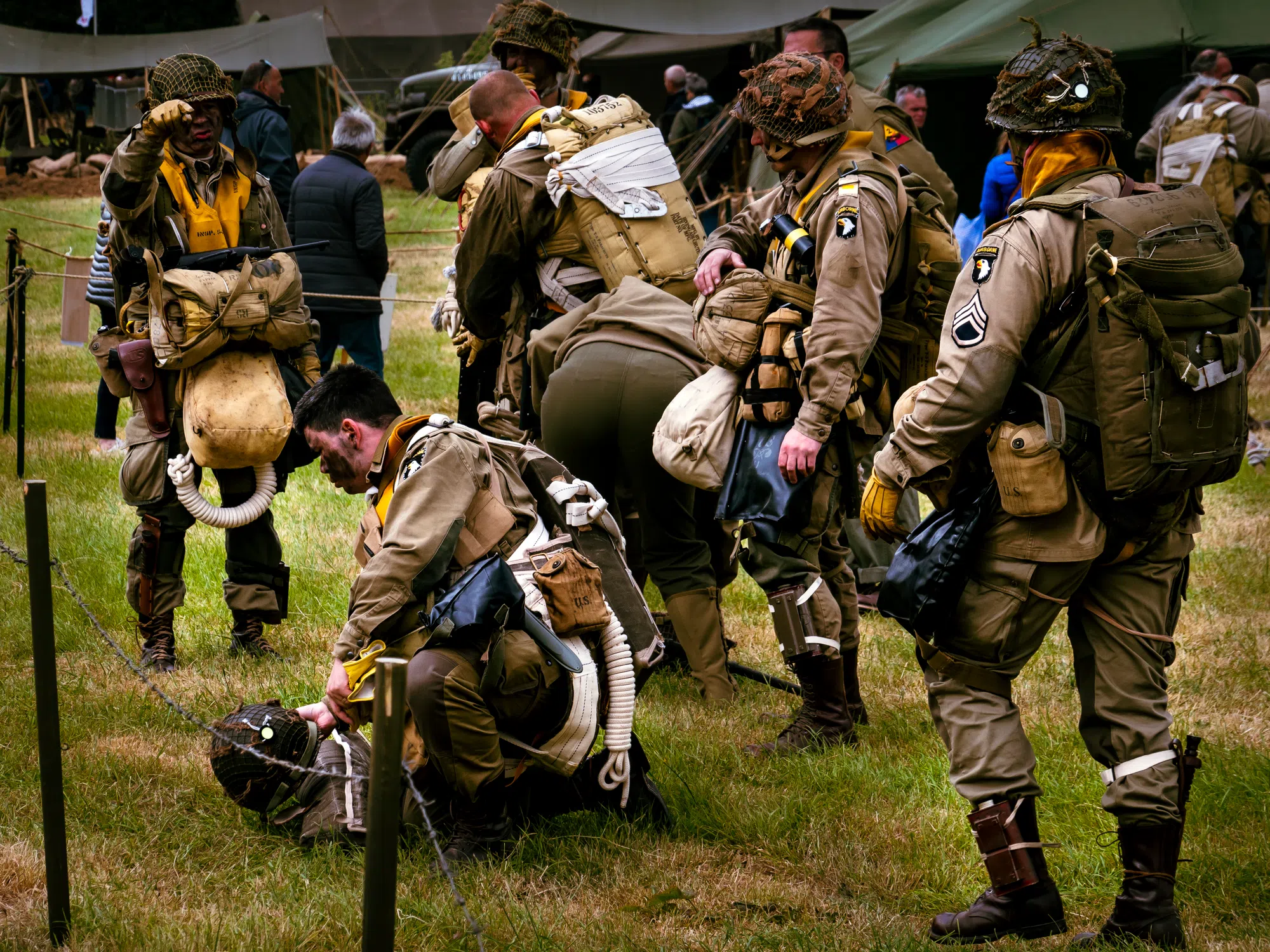
The man who would later call Lexington his home was about ready to make the airborne jump into Normandy on the eve of D-Day, along with 6,000 of his 101st Airborne Division comrades.
Hutt, like 10 million other Americans, had been drafted and inducted into the military. Before the war he said, during a past interview, he worked at the Douglas aircraft factory in California. He said he was recruited in Los Angles and he officially joined the Army in September 1942.
He decided to volunteer for the Airborne, a radical new concept for the U.S. Army, but one which was being put to together after the military had seen the German successes in battles at Belgium and Crete when they employed their Fallschirmjager, paratroopers, to great success.
“We were doing stuff which had never been done before,” Hutt said in a past interview with Lexington High School students.
Hutt, like many of his comrades, must have been drawn to the airborne due to their elite nature. They had different emblems they wore, once through jump school they would acquire silver wings to wear over their left pocket. Airborne units also got the right to tuck their trousers into their boots, a status symbol of the airborne and something they lorded over the regular army troops mercilessly.
Hutt said he was a rifleman and would have learned how to take apart an M-1 Garand, 30.06, rifle apart blindfolded.
Arriving in England in the fall of 1943, Hutt and the 506th were here to prepare for the invasion of France. By early 1944 the training had become focused on larger units as the entire airborne divisions and ground units rehearsed the invasion of Normandy.
The 101st Airborne would be some of the first units on the ground in Normandy. “The task of establishing a beachhead on each side of the Douve River, where the French coast makes a right angle.”
The 506th would be securing four causeways behind Utah beach, the left flank of the D-Day invasion. The Americans would be assaulting with the 4th and 90th Infantry Divisions.
The airborne units would be on their own until the troops from Utah beach were able to move inland, they were going to have to carry all of their necessary equipment with them. Hutt was likely issued the same equipment nearly all of the airborne troops were before the invasion.
One 506th colonel told his men, “Some weeks ago we were notified that the Germans are telling French civilians that the Allied invasion forces would be led by American paratroopers, all of them convicted felons and psychopaths.”
Hutt and his comrades from the 3rd Battalion of the 506th would be landing in Drop Zone D, an area to the north of the town of Carentan and northwest of the village of St. Come-du-Mont. Their objective was to secure the bridges over the Douve River and the village of St. Come-du-Mont.
On the night of June 5, Hutt and the 3rd Battalion loaded up onto the 45 C-47 transport aircraft, flown by the 440th TCG, located at RAF Exeter.
On the eve of D-Day, Lieutenant Colonel Wolverton of the 3rd Battalion said, “a year from today a reunion should take place in the center of the U.S.A, at Kansas City.” It’s a meeting the men of the 3rd Battalion, including Hutt, would honor.
Once the C-47s had taken off and were in the air, they assembled into formations and flew southwest over the English Channel at 500 feet to stay below German radar. Once over the coast of France, the pilots began running into troubles. For many it was their first time flying into combat and were obviously nervous. A cloud bank over the coast forced many to maneuver to avoid airborne collisions. Then the German anti-aircraft fire opened up.
The 20- and 40-mm guns began to fire at the C-47s as they flew low over the Normandy countryside. Many described the sound of their planes being hit as, “rocks being shaken inside a can.”
The first and second waves of paratroopers were scattered all over the area as the lost and bewildered pilots accelerated to 150 mph, far too fast, and signaled the paratroopers to jump regardless of their location.
The third wave’s pilots were more precise, but so were the German gunners. The flight lost six aircraft to flak, but they made an accurate drop, placing 94 of 132 groups close to the drop zone. Hutt leaped out of the aircraft and descended down as anti-aircraft fire continued to light up the sky.
There was a problem though. The drop zone was an obvious one and the Germans had guessed it would be the location for a parachute assault. They had pre-registered the area for mortar fire and set up machine guns overlooking the area.
The Germans had set a trap.
Before many could struggle out of their parachutes, the Germans opened fire. The consequences were deadly. In a span of 10 minutes two of the three battalion commanders were killed, including Lt. Col. Wolverton and executive officer Maj. George Grant, along with a large portion of the battalion.
“A lot of the guys with me got killed,” Hutt said.
Hutt managed to hit the ground with a companion, and they were able to knock out one German machine gun nest. They were approaching a second when the Germans discovered them and opened fire.
Hutt took an MG-42 round in the leg and his companion was killed. Soon after a pistol slug entered his leg. He was incapacitated by the bullets and crawled into a hole where he remained the entire night.
At daybreak, the morning of D-Day, the German’s began investigating who had attacked them in the middle of the night. They found Hutt and according to his youngest daughter Dee Weaver, one German wanted to execute him, but another talked him down and Hutt was taken prisoner.
The only part of the battalion which escaped unscathed was those who were dropped in the wrong area. Hutt said later he learned after the war after 20 days of fighting, of the 125 men who had jumped with him only 38 had not been killed, wounded or captured.
Hutt would spend the rest of the war in Germany as a prisoner of war. He along with the other 93,941Americans who found themselves as POWs in Germany, the Germans generally adhered to the measures in the Geneva Convention. Germany also feared reprisals against German POWs which were being held in the United States.
Hutt was moved several times in France, he was given some treatment for his wounds, Weaver said a 90-year-old German doctor removed the bullets with no anesthetic.
Hutt was eventually German POW camp Stalag III-C located in Brandenburg, Prussia, according to the National Archives POW database. By December 1944, he was one of the 2,036 Americans being held in the camp. Many of the prisoners were used to work in the industrial sites or farms located near Brandenburg.
Hutt said in a past interview the living conditions and treatment were fair. His diet consisted of dark bread and soup.
In late 1944 Hutt and the prisoners began to learn the Red Army was nearing the camp and they soon might be liberated. The guards made attempts to move them but after they found out the Russians had surrounded the camp, they fled, and leaving the prisoners in the camp.
Hutt said on Jan. 31, 1945 the Soviet Red Army liberated the camp. Hutt and a few men made their way foot, horse drawn carts and a few truck rides to reach Warsaw, Poland. He was eventually moved by train to the city of Odessa on the Black Sea and was eventually repatriated.
Hutt and the men from the 3rd Battalion would go on and honor the late Lt. Col. Wolverton’s request to hold a meeting in the center of the United States. On June 7, 1946 a reunion was held at the Muelbach Hotel in Kansas City, Mo.
During the reunion, a memorial service was held for all of the men of 3rd Battalion who were killed during the war. Hutt was pictured with his comrades and their spouses at the event.
Hutt later returned to Nebraska and lived in Lexington. He died on June 13, 2000 at the age of 82 and is buried at the Fort McPherson National Cemetery.